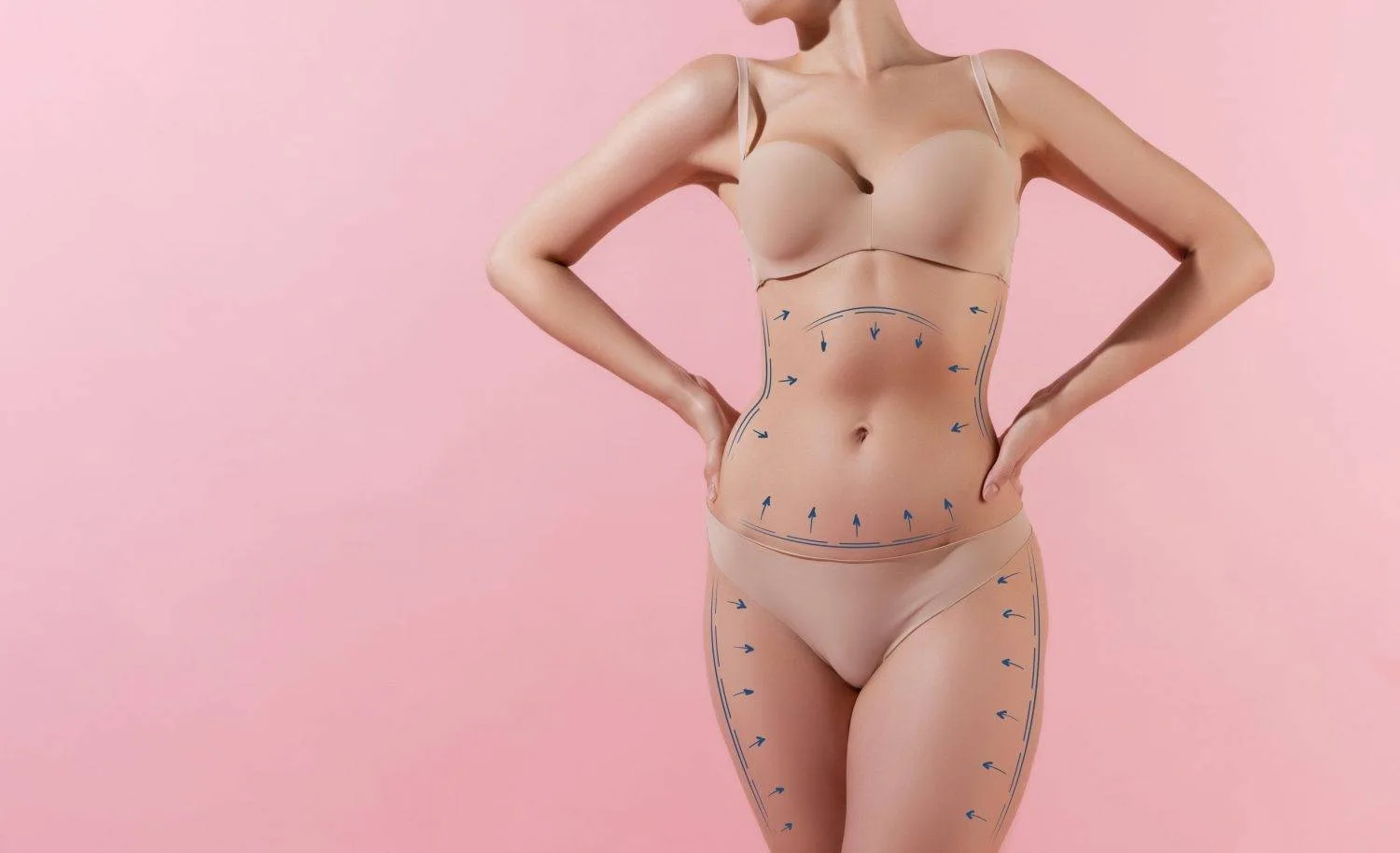


The UK is in the middle of a rapid, medically driven transformation, and it’s not ending where most people think it does. The explosive uptake of GLP-1 weight loss injections has reshaped how the nation loses weight, delivering results at a speed and scale that traditional dieting never could.
But weight loss is not the end of the journey.
For many patients, significant weight loss and body changes can create new goals around confidence, body contour, skin quality and overall shape. Rather than framing surgery as a consequence, the data suggests many people are increasingly researching what the next stage of transformation could look like.
Search behaviour, procedure demand and market signals all point in the same direction: GLP-1 medications may be influencing broader demand across both surgical and non-surgical aesthetics.
To understand the scale of this shift, we analysed five years of UK search data, combining Google Trends patterns with real search volumes from Ahrefs and cross-referencing them against cosmetic procedure demand and pricing data. Taken together, these datasets suggest changing patient priorities – where weight loss, body confidence and aesthetic treatments are becoming more closely connected.
The Ozempic Summer Body Panic
Our research shows us that Britain’s appetite for weight loss injections doesn’t follow a flat, year-round curve. It spikes. And almost immediately afterwards, so does the demand for the cosmetic procedures that address what the injections leave behind.
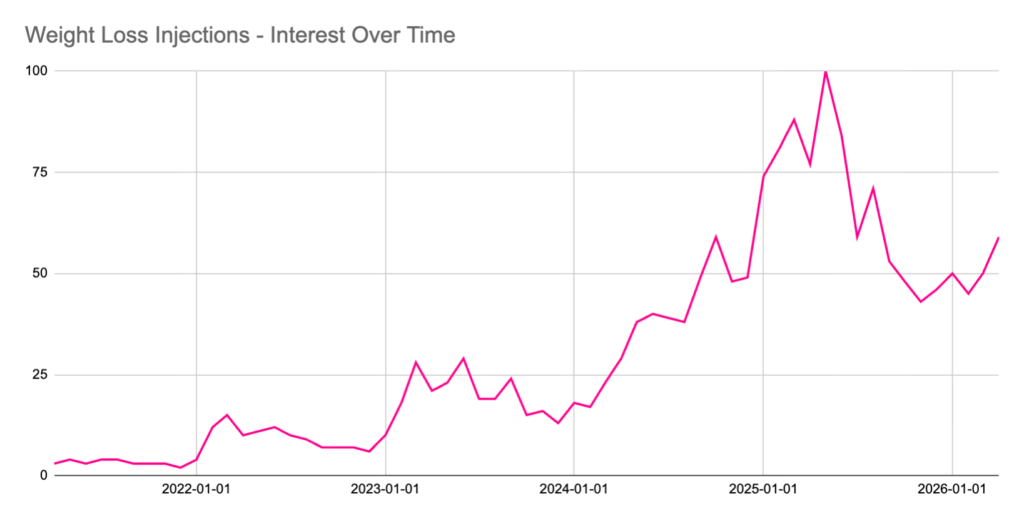
Google Trends data tracking searches for “weight loss injections” shows a consistent and dramatic seasonal pattern:
- Interest climbs sharply in January and February
- Surges through spring, and peaks in early summer
- Falls away through autumn and winter – before repeating the cycle the following year, each peak higher than the last
In May 2025, the search index hit 100 –its absolute peak. On Google Trends, a score of 100 represents the moment of highest search interest for a term within the selected period – in other words, weight loss injections have never been more searched for in the UK than they were that month. By winter, it had dipped to 43, before climbing again to 59 by April 2026. Search demand for cosmetic procedures appears to follow a broadly similar seasonal rhythm, with rising interest in treatments such as tummy tuck, face lift and body contouring during peak spring and summer periods. While search data cannot confirm direct causation, it does suggest that seasonal body-confidence motivations may be shaping interest across multiple treatment categories.
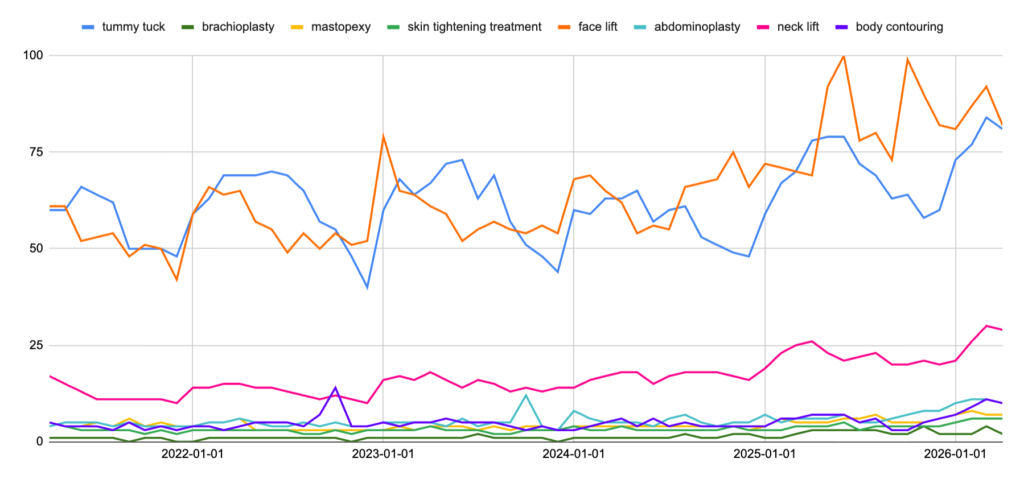
This isn’t a gradual, passive trend. It appears to be a seasonal concern, playing out across millions of search queries, at growing scale:
- Face lift searches hit their all-time high of 100 in late spring/early summer of 2025, before reaching the same peak again later in 2025.
- Tummy tuck searches reached 84 in March 2026 – their highest point in five years of data
- Neck lift and abdominoplasty searches are both near five-year highs heading into spring 2026.
For aesthetic providers, this may indicate that the pathway from weight management to confidence-led treatments is becoming more mainstream each year.
Beyond the Face: The Real Ozempic Effect Affects the Whole Body
“Ozempic face” entered the popular lexicon around 2023 – the gaunt, hollowed appearance that rapid GLP-1-assisted weight loss can produce. It lodged itself in public consciousness as the defining cosmetic side effect of the weight loss jab era.
But the face, it turns out, is only part of the story.
Search data tracking UK interest in cosmetic procedures since 2021 reveals that the fastest-growing procedures are precisely those that address what happens to the body below the neck when significant weight is lost at speed:
- Tummy tuck searches: up 45% since 2021, with 16,000 monthly searches in early 2026 – the highest volume of any procedure tracked
- Neck lift searches: up 133%
- Body contouring: up 200%
- Abdominoplasty: up 175%
- Brachioplasty (arm lift): from near-zero in 2021 to its highest ever level in 2026
Meanwhile, the keywords that explicitly link weight loss drugs to physical consequences are exploding. Between 2024 and 2026:
- “Mounjaro face” went from 31 searches to nearly 7,000 – a rise of over 22,000%
- “Ozempic face” now commands 53,292 monthly searches
- “Mounjaro loose skin” is up 1,206% in just two years
The public has moved well beyond awareness of the facial effects. They are now searching for solutions to what these drugs do to arms, stomachs, necks and thighs. The broader picture reinforces the scale of the shift: Mounjaro – recording zero searches in 2021 – now sits at an index of 89 in Google Trends. Wegovy is up 263% since 2021. GLP-1 searches on Ahrefs have grown 478% between 2024 and 2026.
The Ozempic effect is not only a facial phenomenon, but a full-body reckoning, and the search data suggests the UK is only beginning to deal with it.
A Potential Turning Point for Surgical Demand
For much of the past decade, the aesthetics market has been shaped by the rise of non-surgical treatments – faster procedures, lower upfront costs and minimal downtime helping drive mainstream adoption.
However, market indicators now suggest the picture may be evolving. Search demand for procedures such as tummy tuck, neck lift and body contouring is rising, while clinics are reporting renewed interest in treatments designed to address more significant structural changes after major weight loss.
It is impossible to attribute that shift to any single cause. But the rapid growth of GLP-1 medications may be one factor helping to reshape demand – particularly where patients are seeking outcomes that non-surgical treatments alone may not always deliver.
The Hidden Cost of Weight-Loss Jabs
The monthly cost of weight loss injections is well-documented. Wegovy and Mounjaro typically cost between £150 and £250 per month privately, with many patients remaining on them for a year or more – a commitment of between £1,800 and £3,000 before the treatment even concludes.
For some patients, medication may be one part of a wider transformation journey that also includes procedures focused on contour, skin quality or tightening.
Here are the average prices for loose skin correction procedures in the UK.
Liposuction – one of the most commonly sought procedures among post-weight-loss patients looking to address stubborn, redistributed fat – ranges from £3,000 for a single area regionally to £15,000 or more for multiple areas at a premium London clinic. A thigh lift, which addresses the loose skin along the inner and outer thighs that significant weight loss so often leaves behind, costs between £6,000 and £10,000. For patients requiring correction across multiple areas of the body – stomach, arms, thighs, chest – a comprehensive body lift can reach £25,000 at a London clinic.
For context, a patient spending £200 a month on weight loss injections over 18 months will have invested around £3,600 in their treatment. The surgical bill to address what those injections leave behind could be three to seven times that figure, and for those requiring full-body correction, potentially more.
What Comes Next
The data points to a shift that is not temporary, but structural. Weight-loss injections are changing not just how people lose weight, but what they expect their bodies to look like afterwards – and what they are willing to do, and spend, to achieve that outcome.
As GLP-1 medications become more accessible and potentially move further into mainstream and NHS-supported use, the number of patients experiencing rapid, medically assisted weight loss will continue to grow. With that comes an inevitable second wave: individuals seeking to resolve the physical consequences that follow.
Clinics are already adapting. We are likely to see cosmetic providers reposition services specifically around post-weight-loss transformation, bundling procedures, consultations, and financing options to meet this new demand profile.
At the same time, patient awareness is accelerating. What was once an unexpected side effect is quickly becoming an anticipated part of the journey. Increasingly, those starting weight loss injections are doing so with a clearer understanding that surgery may follow.
The implication is clear: the true cost of the UK’s weight loss jab boom is not just measured in monthly prescriptions, but in the downstream medical, financial and psychological commitments that come after. The “before and after” is no longer a two-stage story – it is becoming a multi-step pathway, with cosmetic intervention as a predictable finish line.
Methodology
Our research examines the link between rising use of weight loss injections in the UK and growing demand for cosmetic procedures, using three complementary data sources.
- Google Trends: Monthly UK data (April 2021–April 2026) tracked search interest in “weight loss injections” alongside key procedures such as tummy tuck, face lift, neck lift, brachioplasty, abdominoplasty, and body contouring. Trends data (indexed 0–100) was used to identify directional patterns, seasonality, and year-on-year changes.
- Ahrefs Search Volume: Absolute monthly search volumes were analysed for 2024 vs 2026 across weight loss drug terms (e.g. Mounjaro, Wegovy, GLP-1, Ozempic face) and cosmetic procedures. This validated the Trends patterns with real search demand and enabled percentage growth comparisons.
- Pricing Data: UK treatment costs were sourced from publicly available clinic pricing. Procedures were grouped into non-surgical, minimally invasive, and surgical categories, with prices shown as ranges to reflect variation by treatment and location.